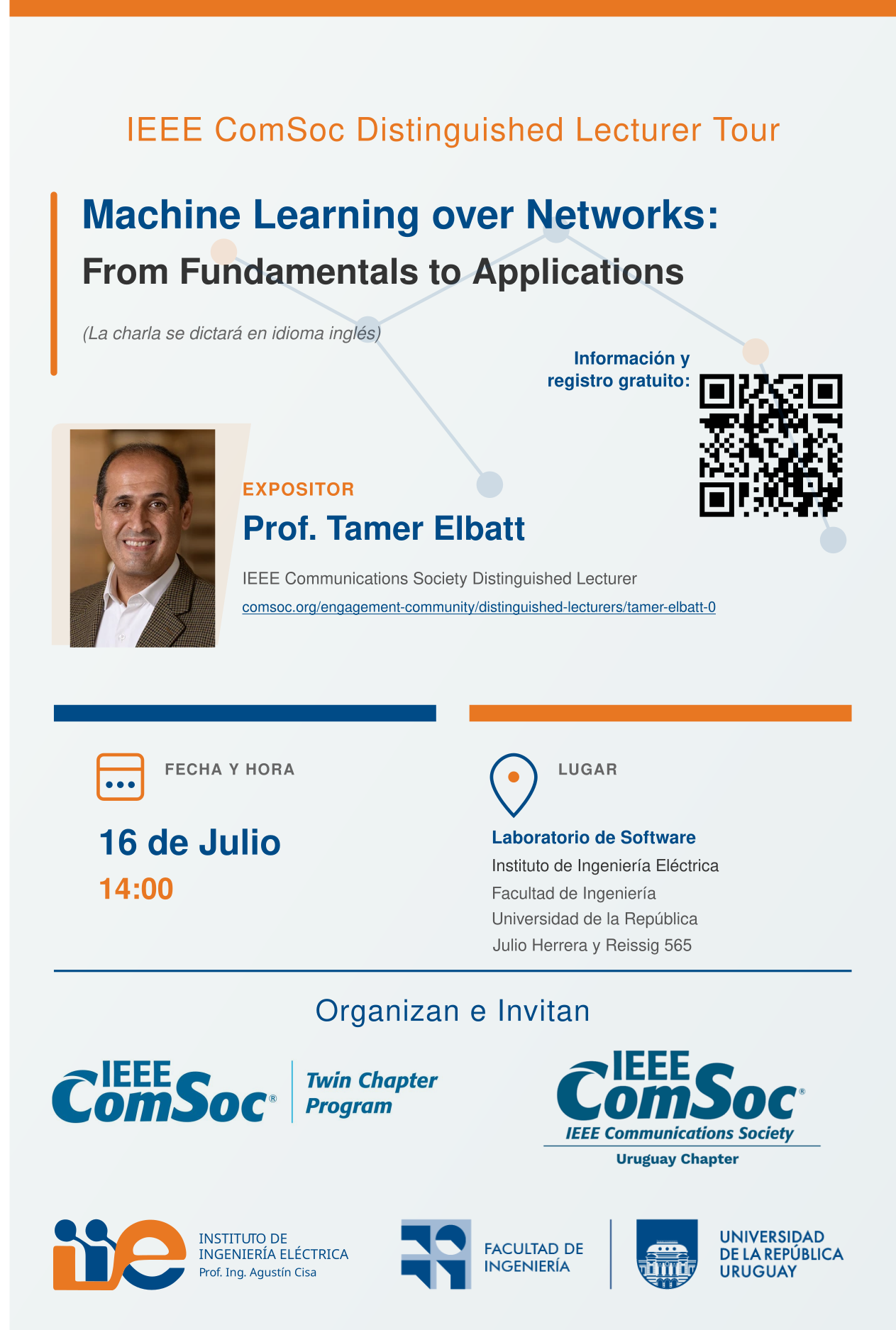
El Instituto de Ingeniería Eléctrica (IIE) y la IEEE, invitan a la charla "Machine Learning over Networks: From Fundamentals to Applications", que será brindada por el profesor Tamer ElBatt, de la American University in Cairo, Egipto. La actividad se realizará el jueves 16 de julio a las 14 horas en el Laboratorio de Software del IIE y se desarrollará en inglés.
La entrada es libre y gratuita, pero se solicita realizar una inscripción previa por motivos organizativos.
Datos de la charla
- Fecha: jueves 16 de julio
- Hora: 14:00
- Lugar: Laboratorio de Software del Instituto de Ingeniería Eléctrica (IIE)
- Idioma: inglés
- Inscripciones: https://events.vtools.ieee.org/m/566127.
Resumen de la charla
In this talk, we review sample results based on our recent work in the areas of machine learning over networks and edge intelligence. In particular, we touch upon our work on communication-efficient federated learning, IoT systems with edge intelligence and federated learning applications in digital health.
In the first part of the talk, we shed light on two topics pertaining to federated learning and multi-tier intelligence. The first is the design of communication-efficient federated learning. In particular we introduce and evaluate, using a public data set, a second-order federated learning algorithm, coined Fed-Sophia, with computation and communication efficiency merits. Afterwards, we shift our attention to edge intelligence for IoT. We design and prototype a multi-tier computing system, with distributed machine learning, for a use case of vehicle tracking. The results reveal the merits of the proposed three-tier system in terms of prediction performance compared to centralized learning on the same test set, yet, with a significant reduction in the training data.
In the second part of the talk, we shift focus to edge intelligence applications, in particular, federated learning over blockchain networks. Motivated by the wide prevalence of decentralized data, we propose a novel serverless federated learning framework, relying on the distributed ledger security infrastructure of blockchains. This is achieved by employing “validators” who evaluate the quality of the “trainer” model updates through a validation dataset and byzantine fault tolerance. This work opens ample room for future research through revealing interesting insights and fundamental trade-offs.